
Seal Strength vs. Seal Integrity Testing: What’s the Difference?
Two distinct ISO 11607 requirements for sterile barrier systems — one measures how strongly a seal holds, the other confirms it has no leaks. Here is what each test covers and when you need it.
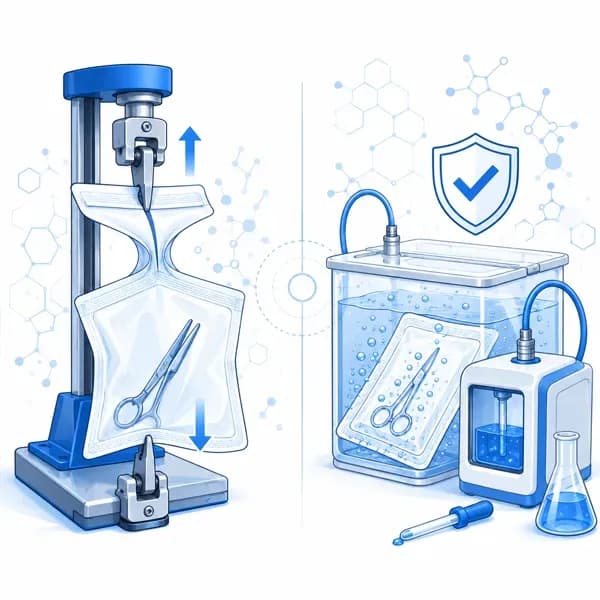
Seal strength and seal integrity are two different things. Seal strength is the mechanical force required to peel a package seal apart, measured per ASTM F88. Seal integrity is the absence of leaks or channel defects in the sterile barrier, detected by methods such as ASTM F1929, F2096, or F3039. ISO 11607 requires evidence of both.
By the LSO Packaging & Validation team · Last reviewed June 2026
Seal Strength vs. Seal Integrity: Test Methods at a Glance
The standards a medical device packaging validation typically draws on, and what each one proves.
| Method | Standard | What it measures | Destructive? | When required |
|---|---|---|---|---|
| Seal strength (peel) | ASTM F88 | Mechanical force required to peel a seal apart | Yes | Design & process validation; material or sealing changes |
| Dye penetration, porous | ASTM F1929 | Leak channels in porous (e.g. Tyvek) seals | Yes | Integrity of porous sterile barrier seals |
| Internal pressure (bubble) | ASTM F2096 | Gross leaks (to ~250 µm) via underwater pressurization | Yes | Whole-package gross-leak screening |
| Dye penetration, nonporous | ASTM F3039 | Leak channels in nonporous foil/film barriers | Yes | Integrity of nonporous flexible packages |
| Visual inspection | ASTM F1886 | Visible channels, voids, and seal defects | No | Routine in-process & 100% release inspection |
Why ISO 11607 requires both
Seal strength: how strong is the seal?
ASTM F88 pulls a strip of the seal apart and records the peak force, reported in newtons per 15 mm (or lb/in). A seal that is too weak can burst during sterilization, distribution, or aseptic presentation; one that is too strong can tear the porous web on opening and shed fibers into the sterile field. Because the test destroys the sample, seal strength is used for design and process validation under ISO 11607-2 — not for 100% release.
Seal integrity: does the seal leak?
Even a strong seal can hide a microscopic channel that lets microbes in, so integrity is tested separately. ASTM F1929 wicks a dye through channels in porous (Tyvek) seals; F3039 does the same for nonporous foil and film; F2096 pressurizes the package underwater to reveal gross leaks down to roughly 250 µm. Under ISO 11607-1, integrity of the sterile barrier system is a separate, mandatory requirement — passing a strength test does not satisfy it.
For most Class II/III sterile devices, a complete packaging validation runs seal strength and seal integrity testing together, often alongside accelerated aging and distribution simulation, in an ISO 17025 accredited packaging lab.
ASTM F88, F1929, F2096, and F3039 are all listed on LSO’s ISO/IEC 17025:2017 scope of accreditation. Download the certificate and scope (PDF).
FDA-Registered
Manufacturing Facility
ISO 13485
Certified Quality System
12 Cleanrooms
Class 5–8
125,000+ Sq Ft
Regulated Manufacturing
3 Facilities
CA | NH | Costa Rica
ISO 17025
Accredited Packaging Lab
Seal Strength vs. Seal Integrity: FAQ
No. Seal strength is the mechanical force needed to peel a seal apart (measured per ASTM F88), while seal integrity is the absence of leaks or channel defects in the sterile barrier (verified by methods such as ASTM F1929, F2096, or F3039). A package can have adequate seal strength yet still fail integrity if a microscopic channel lets contaminants through.
Seal strength testing (ASTM F88) quantifies how strongly a seal resists peeling, reported as force per unit width. Seal integrity testing detects whether the package leaks at all — dye penetration (ASTM F1929 for porous, F3039 for nonporous) and internal-pressure bubble tests (ASTM F2096) reveal channels and breaches. Strength is a "how strong" measurement; integrity is a "pass/fail" for leaks.
ISO 11607-1 — the consensus standard the FDA recognizes for terminally sterilized medical device packaging — requires demonstrating both seal strength and seal integrity for the sterile barrier system. Most validation programs run ASTM F88 for strength alongside an integrity method (F1929, F2096, or F3039) chosen to match the package material.
Yes. ASTM F88 is a destructive test — the seal is peeled apart to measure the force at failure, so the package cannot be used afterward. It is used for design validation, process qualification, and verifying material or sealing changes, not for 100% release inspection.
ASTM F1929 is a dye-penetration test for seal integrity. A low-surface-tension dye is applied to the seal of a porous package (such as a Tyvek pouch); if the dye wicks through a channel within the time limit, the seal fails. It detects leak paths that a visual inspection would miss.
Usually yes. ISO 11607 treats seal strength and seal integrity as separate requirements, so a typical validation includes ASTM F88 for strength and an integrity method (F1929, F2096, or F3039). Strong seals that still leak — or leak-free seals too weak to survive distribution — both fail in the field.
Related reading
Validate your seal strength and seal integrity with one lab
LSO’s ISO 17025 accredited, ISTA-certified packaging lab runs ASTM F88, F1929, F2096, and F3039 — with data you can submit to FDA. Send us your package and we will review your validation plan.
Or call us directly: (714) 672-1090