
Accelerated Aging Testing | ASTM F1980 | LSO
Accelerated aging calculator based on ASTM F1980 to estimate shelf-life duration. LSO provides integrated aging, sterile barrier testing, and validation
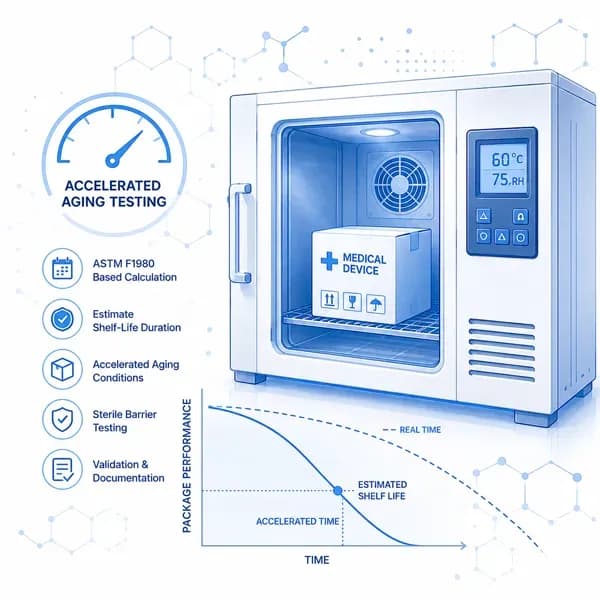
Accelerated aging is a standardized method that uses elevated temperatures to simulate the long-term shelf life of a sterilized medical device package within weeks instead of years, following the ASTM F1980 accelerated aging standard.
LSO performs accelerated aging to help manufacturers establish initial shelf-life claims before real-time data is available. A product can be released to market based upon successful Accelerated Aging test results that simulate the period claimed for product expiration date (1 year, 2 years, etc). Accelerated Aging data is recognized by regulatory bodies as a conservative estimate of the shelf life but is only accepted until those tests can be repeated on “real time” aged samples.
Accelerated Aging Calculator (ASTM F1980)
Use this calculator to estimate real-time shelf-life equivalents from accelerated aging study durations.
Enter your conditions and target shelf life to estimate how many days of accelerated aging you need — based on the ASTM F1980 Arrhenius model.
Acceleration Factor (AAF)
9.85×
AAF = Q₁₀(T₁−T₀)/10 = 2.0(55−22)/10
How long do I need to age?
Enter the real-time shelf life you want to claim. We'll calculate how many days of accelerated aging you need to support it.
Required accelerated aging time
74 days
≈ 2.4 months at 55 °C to simulate 2.0 years (731 days) at 22 °C
Reference table — shelf life from common accelerated durations
| Accelerated aging time | Real-time shelf-life equivalent |
|---|---|
| 7 days | ≈ 69 days (2.3 months / 0.19 years) |
| 14 days | ≈ 138 days (4.5 months / 0.38 years) |
| 30 days | ≈ 295 days (9.7 months / 0.81 years) |
| 60 days | ≈ 591 days (19.4 months / 1.62 years) |
| 90 days | ≈ 886 days (29.1 months / 2.43 years) |
| 180 days | ≈ 1,773 days (58.2 months / 4.85 years) |
| 365 days | ≈ 3,595 days (118.1 months / 9.84 years) |
Best Practices for the Best Results
Quick reference to make sure the values you enter give you results you can defend in a validation report.
What each field means
- Ambient temperature (T₀)
- The normal, real-world storage temperature your product is intended to be kept at throughout its shelf life.
- Accelerated aging temperature (T₁)
- The elevated temperature used during testing to artificially speed up the aging process.
- Q₁₀ factor (aging factor)
- A multiplier that represents how much the aging rate increases for every 10 °C rise in temperature — typically defaulted to 2 for most products.
- Real-time shelf life equivalent
- The target lifespan you want your product to achieve under normal storage conditions, expressed in days, months, or years. You enter this above.
- Accelerated aging time (days)
- The calculated length of time your product must spend at the elevated test temperature to simulate the desired real-time shelf life.
- Accelerated aging factor (AAF)
- The ratio that describes how much faster aging occurs at the elevated temperature compared to ambient conditions.
Do
- Double-check that your temperatures are entered in Celsius (°C) — this calculator uses Celsius only.
- Confirm your real-time shelf life is entered in the correct unit (days, months, or years).
- Recalculate any time you change a value — small differences in T₁ or Q₁₀ can shift the result significantly.
- Want to make sure your results are on point? Our team is here to help — contact us to verify your inputs before you commit a study.
Don't
- Don't assume a Q₁₀ of 2 is universally accurate — it varies by product, material, and degradation mechanism.
- Don't round your temperatures aggressively — even a 1–2 °C error compounds significantly over longer projected shelf lives.
- Don't leave any field at its default value without confirming it applies to your situation.
- Don't enter the same value for both ambient and accelerated aging temperatures. If you're unsure, reach out and we'll help confirm your inputs.
Estimates only. Actual study design should be confirmed with a packaging-test engineer and supported by real-time aging per ASTM F1980. LSO offers full accelerated + real-time aging programs from our Anaheim and Costa Rica facilities.
Example Aging Duration Calculation
Using an elevated temperature of 55°C and an ambient temperature of 23°C with Q10 = 2:
- Aging Factor (AF) = Q10^((Test Temp – Ambient Temp) / 10)
- AF = 2^((55 – 23) / 10) ≈ 9.2
- Three-year shelf life = 1,095 days
- 1,095 / 9.2 ≈ 119 days of accelerated aging
When Accelerated Aging Is Appropriate
Accelerated aging is used when the sterile barrier system is made from heat-stable, well-characterized materials, and the device has a shelf-life claim of five years or less. It provides a scientifically supported estimate of long-term stability when paired with real-time data.
Common applications include:
- Tyvek/poly pouches
- PETG trays with Tyvek lids
- Film-foil pouch systems
- Rigid and semi-rigid sterile barrier systems
- Devices sterilized by EO, gamma, steam, or e-beam
Q: When is accelerated aging acceptable for medical devices?
A: It is acceptable when packaging materials and sterilization methods are stable under elevated temperatures and supported by historical performance data.
When Accelerated Aging Should Not Be Used
Accelerated aging alone is not sufficient when:
- Packaging materials lack heat-stability data
- Components soften, deform, or absorb moisture at test temperatures
- Novel materials may degrade through oxidation or humidity, not heat
- Real-time aging is required for full regulatory verification
Q: When is accelerated aging not enough on its own?
A: It is not enough when material heat stability is unknown or when regulators require real-time aging to verify long-term performance.
Test Parameters and Methodology
LSO performs accelerated aging in accordance with ASTM F1980 using validated environmental chambers and continuous monitoring. The Arrhenius equation determines the relationship between elevated temperature and the equivalent real-time aging duration.
Typical parameters:
- Test temperature: 50–60°C (most commonly 55°C)
- Ambient baseline: 22–25°C
- Q10 factor: Default of 2.0 which indicates that the chemical reaction rate of the materials doubles for every 10°C unless material-specific data supports otherwise.
- Relative humidity: Can be controlled or uncontrolled depending if the package materials or device is hydrolytic or corrosive. If controlled, 45% to 55% is suggested by the standard. If uncontrolled, the relative humidity drifts below 20% RH throughout the course of the aging cycle.
- Duration: Determined by shelf-life claim and selected test temperature
Q: What is the standard temperature for accelerated aging?
A: Most studies use 50–60°C with a Q10 value of 2.0 to simulate long-term shelf life per ASTM F1980.
Q: How long does accelerated aging take to simulate 1 year?
A: At 55°C and 23°C with Q10 = 2, one year of real-time aging can be simulated in about 40 days.
What Follows Accelerated Aging
After accelerated aging, samples undergo sterile barrier integrity testing to confirm package performance throughout the simulated shelf life.
LSO performs:
Q: What tests follow accelerated aging?
A: Seal strength, bubble leak, dye penetration, and visual inspection are typically used to confirm sterile barrier integrity.
Regulatory Framework
How LSO Executes Accelerated Aging
LSO manages the entire accelerated aging workflow, including sample handling, chamber monitoring, and downstream sterile barrier testing. Our process includes ASTM F1980-based study design, calibrated chamber qualification (IQ/OQ/PQ), continuous temperature and humidity monitoring throughout the study, scheduled sample pulls at defined intervals, and integrated downstream package integrity testing — seal strength, bubble leak, dye penetration, and visual inspection — to confirm sterile barrier performance at each timepoint.
Why Medical Device Manufacturers Choose LSO
As an FDA-registered, ISO 13485-certified, ISTA-certified packaging testing lab, LSO provides ASTM F1980 study design and execution, calibrated environmental chambers run on-site (no third-party scheduling delays), full IQ/OQ/PQ documentation with chain-of-custody traceability, and integrated downstream sterile-barrier testing under one roof. Manufacturers get a single accountable partner for accelerated aging, real-time aging, and the package integrity tests that validate shelf-life claims — all backed by direct access to LSO's packaging-test engineers.
Talk to a Medical Package Testing Specialist
Speak with an LSO specialist to scope your accelerated aging study, calculate duration, or integrate downstream sterile barrier testing.
Frequently Asked Questions About Accelerated Aging
Accelerated aging is a test method that uses elevated temperatures in a shortened period of time to simulate the long-term shelf life of sterile medical device packaging.
ASTM F1980 is the primary standard that defines how to perform accelerated aging for sterile barrier systems used with terminally sterilized medical devices.
The accelerated aging calculator applies the Arrhenius equation from ASTM F1980 to calculate an aging factor. The equation considers elevated temperature, ambient (real-time) temperature, and a Q10 factor to determine actual aging durations that help support shelf-life claims.
Most accelerated aging studies use temperatures between 50 °C and 60 °C, with 55 °C being the most common test temperature for sterile barrier systems.
Q10 is a temperature coefficient that describes how reaction rates change with temperature, and LSO typically uses a Q10 value of 2.0 unless material-specific data supports a different value.
At 55 °C with an ambient (real-time) temperature and a Q10 of 2.0, one year of real-time shelf life can be simulated in 40 days. If any of the temperatures or factors change, the duration changes.
Accelerated aging does not replace real-time aging; it provides an initial estimate of shelf-life that must be confirmed with ongoing real-time aging studies.
Accelerated aging is suitable for heat-stable, sterile barrier systems such as Tyvek pouches, PETG trays with Tyvek lids, film-foil pouches, and other packaging materials with documented temperature stability.
Accelerated aging is not appropriate when packaging materials lack heat-stability data, when temperature is not the primary driver of degradation, or when regulators require real-time data for final shelf-life verification.
After accelerated aging, LSO performs sterile barrier integrity testing such as visual inspection, bubble leak testing, dye penetration testing, and quantitative seal strength testing to confirm package performance over the simulated shelf life.
FDA-Registered
Manufacturing Facility
ISO 13485
Certified Quality System
12 Cleanrooms
Class 5–8
125,000+ Sq Ft
Regulated Manufacturing
3 Facilities
CA | NH | Costa Rica
ISO 17025
Accredited Packaging Lab
Ready to get started?